
BOP Marion County Release Paths
No federal prison was identified within Marion County in the official sources reviewed. Federal custody can still follow a local booking. A federal defendant may be held locally under an agreement, taken by the U.S. Marshals Service for court and transport, and later committed to a BOP-operated or contracted prison. Each step is a custody handoff. The local roster ends when Marion County gives up physical custody, but that event alone says nothing about later federal release.
A BOP prisoner may leave prison at sentence completion, enter a form of community confinement, or move among federal locations. Public locator wording and the displayed date must be read together. The county booking/release record remains the source for the local handoff, while BOP is the source for federal prison status and a federal release result.
Search BOP Federal Releases
The BOP Inmate Locator searches federal inmate records from 1982 to the present. It accepts name-based queries and identifier searches using a federal register, DCDC, FBI, or INS number. An identifier is the stronger route because name spellings, aliases, and common names can produce missed or mistaken matches.
- Start with the federal register number or another supported federal identifier when known.
- If no number is available, search the full name and use age, race, and sex fields to narrow possible matches.
- Compare every returned identity field before selecting a result.
- Read “Released,” “Not in BOP custody,” any location, and the date as a single status statement.
- Compare the federal timeline with the Marion County transfer record and the federal docket.
- Use BOP records or FOIA channels if the public result does not answer the release question.
The locator shown below is the nationwide federal source. BOP provides the live search, which should be consulted for the current status rather than relying on a copied result.
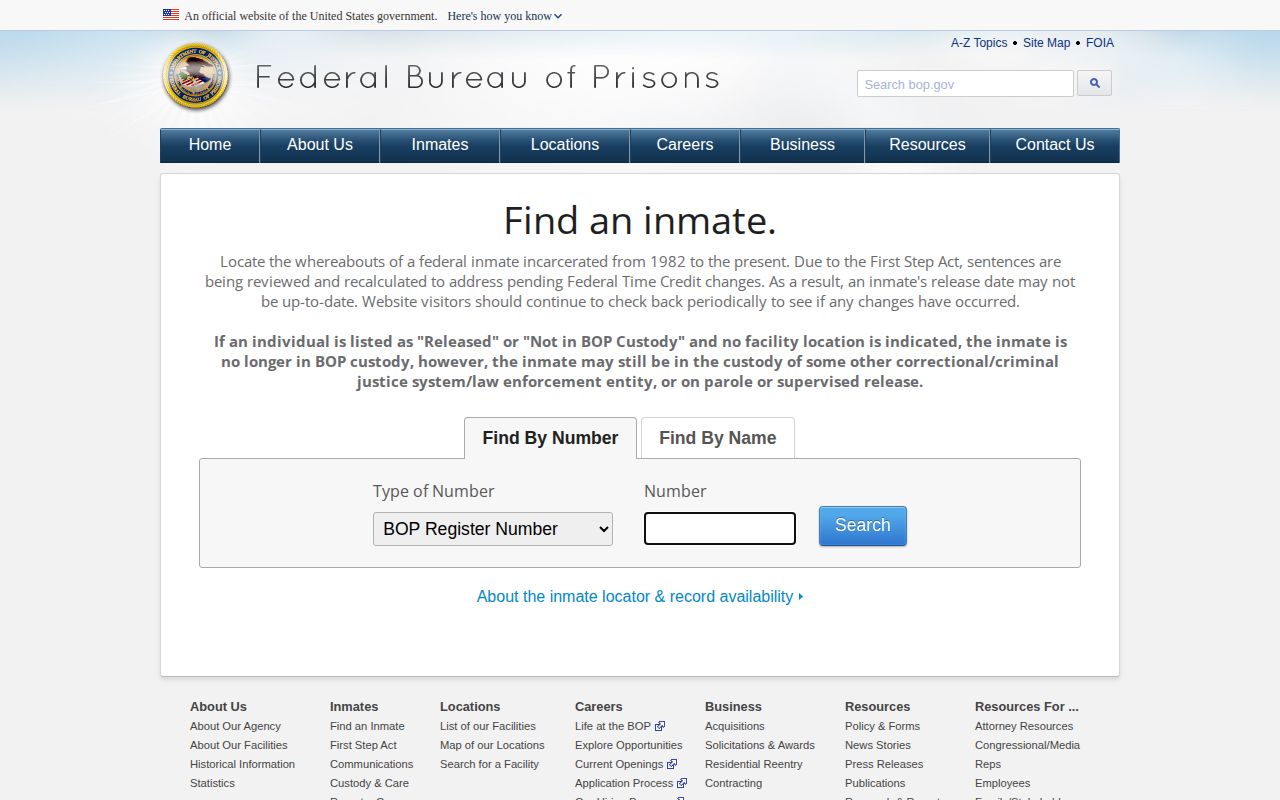
This form does not search Marion County Jail or TDCJ records. It is relevant only when federal prison custody is supported by the case or transfer history.
Read BOP Release Results
A released federal result commonly displays “Released” and a date. Wording such as “Not in BOP custody” should not be isolated from that date or BOP’s explanatory notes. It may describe the end of BOP custody, but the person’s full status can involve supervision, community placement history, another custodian, or a change not described in the compact public result.
| Locator element | Careful reading |
|---|---|
| Register number | The key BOP identity value |
| Released | A public status tied to the displayed federal record |
| Release date | The date BOP reports, not a Marion jail timestamp |
| Not in BOP custody | No current BOP custody; read notes and date together |
| Location | A BOP facility or placement, not county custody |
BOP warns that dates can change. Its locator scope begins in 1982, so older federal records may require National Archives research. A result also may not supply the detailed legal reason for release. The federal docket and a BOP record request serve different purposes and can fill that gap.
Note: A BOP release date is a federal record and must not be restated as the time Marion County custody ended.
Marion USMS Transfer Status
The U.S. Marshals Service manages many federal pretrial detainees and transports prisoners between local facilities, federal locations, and courts. It does not offer a nationwide public former-prisoner locator equivalent to BOP. A Marion County release entry naming USMS therefore establishes a handoff, not a publicly searchable BOP release.
When the county record states “USMS,” use the federal criminal docket through PACER to identify the court, case status, sentence, and later orders. Then contact the appropriate federal authority for custody information it can lawfully provide. A person may remain in pretrial detention, await designation, travel between facilities, or enter BOP only after sentencing. Searching BOP too early can return no match even though federal custody continues.
The sequence matters: Marion County Jail booking, county release or transfer entry, USMS transport or detention, federal court disposition, BOP designation, and later BOP release. Not every federal case follows every step, but the record should establish which steps occurred.
Request Federal Release Records
For detail beyond the public locator, use BOP’s official Freedom of Information Act route. Identify the person with a register number, full name, birth information, and the specific record sought. A focused request might seek the official release date, last BOP facility, custody-status history, or record explaining a public locator entry. Privacy exemptions may limit information about another person.
FOIA does not require BOP to create an explanation that does not exist. Ask for existing records and keep the date range tied to the federal custody episode. The federal court clerk is the proper source for judgments, sentencing documents, and docket orders. BOP is the source for federal prison administration. Marion County is the source for its own booking and receiving-agency notation.
- Federal release
- Departure from BOP custody as reflected in federal records.
- Designation
- BOP assignment to a facility or placement after federal commitment.
- Community confinement
- A federal placement outside a secure prison that may remain under BOP authority.
- Transfer
- A handoff between custodians, not proof of community release.
Federal Release Confirmation Chain
Begin with the Marion County booking/release entry if local custody came first. Ask for the release or transfer date, operational reason, and receiving agency. If USMS appears, find the federal docket. If BOP custody later appears, use the BOP locator and register number. After the public result shows release, retain the federal date as a separate event from the local handoff.
The Marion County release record search covers the local side of this chain. TDCJ is a different statewide system and should be used only for Texas prison custody. ICE is also distinct because its locator covers civil immigration detention and a recent-release window, not federal criminal imprisonment.
These boundaries prevent the most common error: treating the first roster disappearance as the final release. One person can leave Marion County custody, remain with USMS, enter BOP, and leave federal custody much later.
BOP Identity Match Controls
Search failures do not settle custody status. A name may be entered differently, a person may use an alias, or the search may occur before BOP designation. Try the exact federal number from the docket or transfer paperwork. If only a name is known, compare age, race, sex, and any middle name. Do not join records merely because the names match.
The county booking number and federal register number serve different systems. Preserve both when tracing the case. The federal docket number adds a third reference and helps connect the court proceeding to the BOP record. If the dates conflict, ask the originating office for the existing record rather than selecting whichever website looks newer.
Note: BOP’s locator covers federal prisoners from 1982 forward; it is not a general national arrest or jail release database.
About Federal BOP Custody
The Federal Bureau of Prisons operates or contracts for federal prisons nationwide. Its locator is not a physical facility page for Marion County because no local BOP prison was found in the research. The system belongs in the Marion facility map as a contingency route when an actual receiving-agency notation, federal docket, or reliable case information establishes federal custody.
Use BOP only for the federal prison segment. Use USMS and the court for pretrial transport and case status. Use Marion County Jail records for the local episode. This system-specific approach shows where custody ended at each stage and avoids turning a transfer into an unsupported claim of release.
Public Record Search
Sponsored Results