
Marion County Jail Release Paths
A person may leave Marion County Jail after posting a surety or cash bond, receiving a personal bond, obtaining a court order, having a case dismissed, completing time served, or finishing a county sentence. Those events can put the person back in the community. Other exits do not. A transfer to the Texas Department of Criminal Justice, another county, the U.S. Marshals Service, or immigration authorities ends Marion County’s physical custody while government custody continues.
The jail release entry is the key record because it can state the release or transfer date, the operational reason, and a receiving agency when one applies. A court judgment or order helps establish why the jail acted, but it may not show the exact time the person left. IVSS may send a release or transfer notice soon after the event. Read those sources together. A transfer notation proves a handoff, not freedom from custody.
Confirm a Marion Jail Release
The official-linked current inmate directory is useful for one first check. It identifies itself as a list of people currently housed at the jail and supports a name search. It does not offer a released tab, release timestamp, or recent-release window. If a name is absent, move to the custody-change and record channels rather than treating the absence as the answer.
- Search the current roster once using the person’s name and compare booking details when a result appears.
- Check Texas IVSS Counties for a matching custody event or registered notification.
- Call Marion County Jail and ask whether the event was release or transfer.
- Request the existing booking and release entry, including the release authority and receiving agency.
- Pair the jail entry with the Marion County clerk’s judgment or order for the same case.
- If another agency received the person, continue through that agency’s locator or records office.
The broader Marion County released-inmate search and records coverage explains how county, state, and federal paths fit together. Identity should be matched with a booking number or date of birth where available. A shared name alone is weak evidence.
Marion Release Roster Limits
The current directory advertises booking details, charges, bond data, and images when available. Those fields describe a person who is housed now. They do not create a history after the card is removed. Bond data also does not prove that bond was posted, and a listed charge is not a conviction. The roster’s narrow scope is why a released Marion County inmate usually drops from view.
The Marion County Sheriff’s official page supplies the roster’s official provenance and links the county notification service. The screen below shows the current-custody framing. It should be read as a starting point, not a release archive.
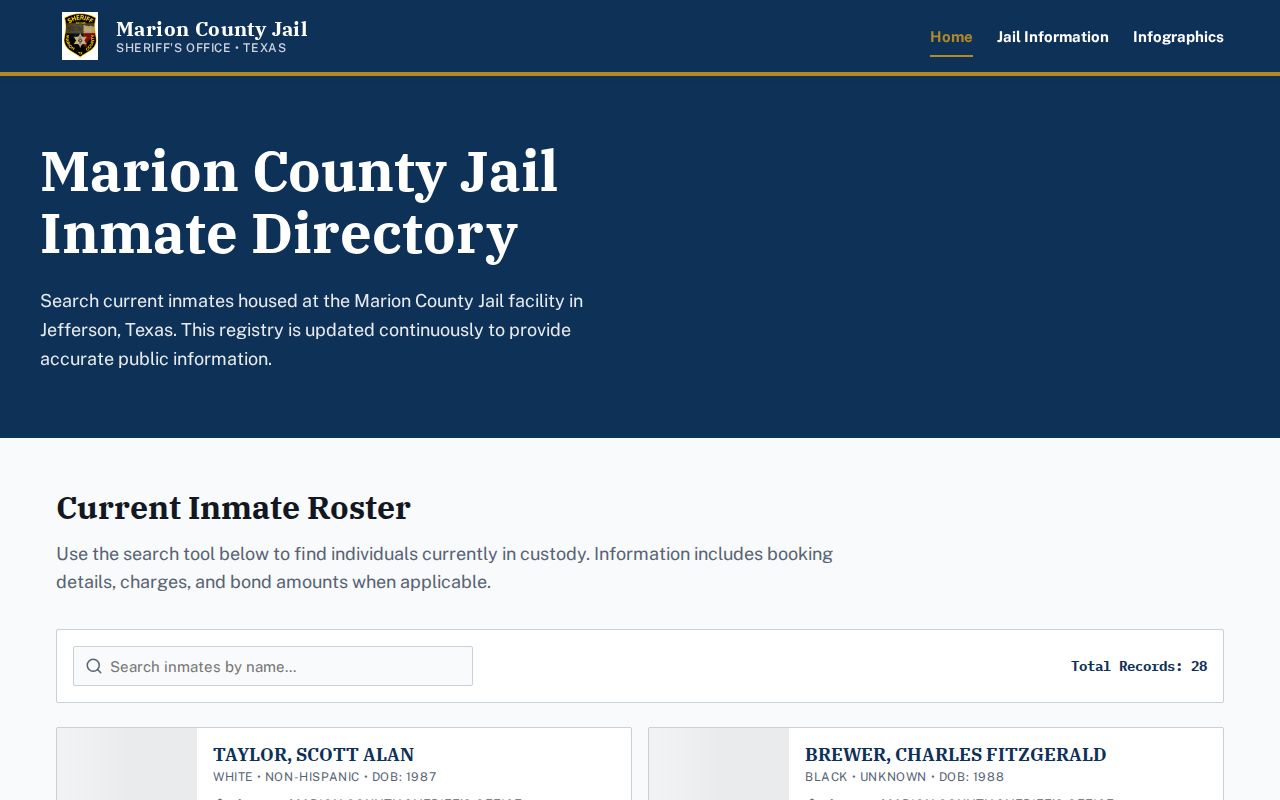
Because this screen does not label former inmates, a release log, IVSS event, or direct jail confirmation is still needed after a name disappears.
Note: Marion County publishes no documented 24-hour or 72-hour release control in the reviewed roster interface.
Request Marion Jail Release Records
Texas Government Code Chapter 552 provides access to existing public information, subject to exceptions. It does not require the Sheriff’s Office to answer legal questions or create a custom report. A narrow request should identify the person and booking episode and ask for the booking sheet, release date and time, release type or authority, receiving agency, and booking photograph if needed.
Send the request to the governmental body that keeps the record. The county does not publish a dedicated sheriff public-information portal, fixed release-sheet fee, or records-unit hours. Confirm the designated submission method with the Sheriff’s Office before sending sensitive identifiers. Ask for electronic copies and an itemized estimate before costs exceed a chosen limit. If no record is found under “release log,” ask whether it is called the jail register, book-in/book-out log, custody history, release order, transfer order, or jail-management event history.
| Requested field | What it can establish |
|---|---|
| Booking number and intake | The exact custody episode |
| Release date and time | When county physical custody ended |
| Release type or authority | Bond, order, sentence completion, or another basis |
| Receiving agency | Whether another custodian took control |
| Booking photograph | The image tied to that booking, if releasable |
Texas retention rules treat the jail register as permanent and preserve certain booking-out and release or transfer material for the stated period after release or transfer. Retention does not make every field unconditionally public. Statutory exceptions and an expunction or confidentiality order may affect access.
Marion Jail Records Contact
Use the jail line for immediate custody and release-or-transfer questions. Use the public Sheriff’s Office contact to confirm public-information routing. No official page states a routine exit time, public waiting area, transport service, or property pickup procedure, so case-specific instructions should come directly from jail staff.
Marion County Jail
102 W. Dallas St.
Jefferson, TX 75657
Phone: 903-665-3271
Availability: Jail phone shown as available 24 hours
Marion County Sheriff’s Office
Sheriff David Capps
114 W. Austin
Jefferson, TX 75657
Phone: 903-665-7201
Do not wait at a secure entrance based on an assumed gate time. Staff can say where an authorized pickup may occur and how property is handled for that particular release.
Marion Release Orders and Courts
A jail entry answers when and how custody ended. The court file can answer why. A judgment may show confinement, jail credit, probation, or another disposition. Docket orders may record bond changes, dismissal, revocation, or discharge. Yet a sentence date is not always the physical release time, and one case’s dismissal does not eliminate a hold in another case.
For felony matters, the Marion County District Clerk is the local gateway. County-level matters go through the County Clerk. Request the judgment or specific order by case number when possible, then compare it with the booking identifier and release entry. This cross-check also guards against confusing two people with the same name.
- Time served
- A disposition crediting confinement already completed.
- Detainer
- A request or legal basis for another agency to take custody.
- Discharge
- The end of a sentence or legal custody obligation, which differs from a transfer.
Marion Jail Transfer Records
A TDCJ notation sends the search to the statewide offender locator, not back to the Marion roster. Match a TDCJ or SID number, county of conviction, birth information, and offense details. A projected release date is not proof of actual departure, and parole eligibility is only the point when review may become possible.
A USMS notation commonly signals federal pretrial custody or transport. The Marshals Service has no public former-prisoner history locator comparable to BOP. A BOP result applies only after federal prison custody and may show “Released” with a date. An ICE notation calls for the immigration locator and the responsible ERO office. No reviewed official source identifies Marion County Jail as an ICE detention facility, so ICE is a case-based contingency, not a routine Marion release route.
Note: Always follow the receiving-agency name recorded by the jail; a missing local roster entry cannot select the next system.
Marion County Jail Custody
Marion County Jail is the county facility operated by the Marion County Sheriff’s Office in Jefferson. It holds people whose custody arises from local booking, court process, county sentences, and agency holds. It is not a TDCJ prison, BOP facility, or identified ICE detention center. Those distinctions control which release record is authoritative.
Historical state jail-comparison material listed the Marion County Jail at 43-bed capacity and an average daily population of 32 for 2021–22. Those dated figures provide scale only. They are not current occupancy, annual booking volume, or annual release counts. Current capacity or population should not be inferred from them.
For a person who returned to the community, the county release entry and related court record are the strongest local evidence. For a person handed to another custodian, the county record marks the transition and the receiving system documents what happened next.
Public Record Search
Sponsored Results